


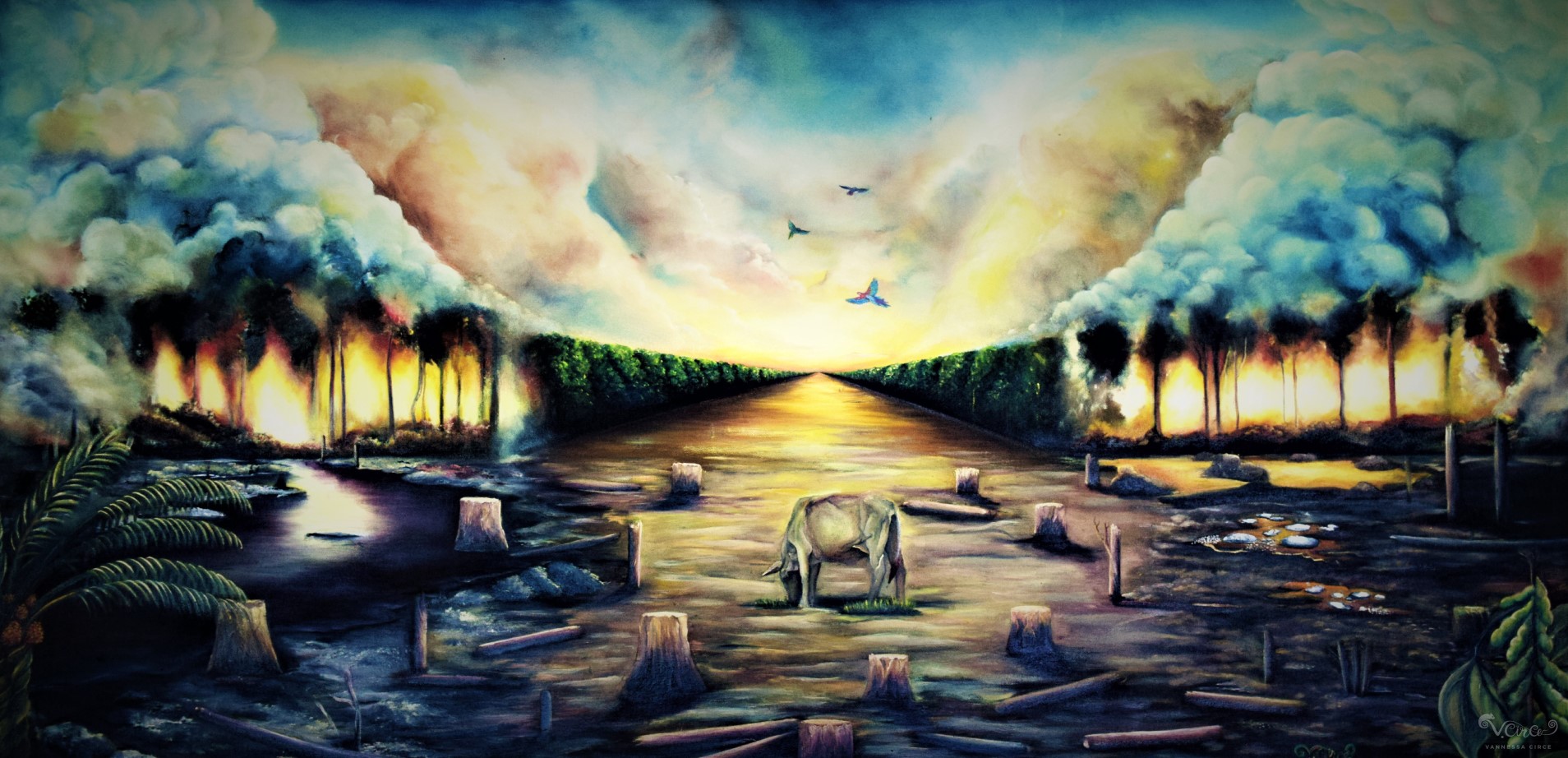
Oil on Canvas
27” x 54” – August 2018
While Colombia has several clear direct drivers of land cover change and deforestation, both legal and illegal in nature (though the line between the two is often blurred), some fundamental social and governmental mechanisms and infrastructure developments are likely the most important drivers of deforestation in Colombia, though they are indirect in nature and hard to quantify. The laws of land titling encourage the clearing of land, regardless of whether or not that land is converted from forest into something commercially productive or sustainable, and whether or not that land was gained through violence and forced displacement of people with or without legal tenure to the land. Much “land-grabbing” is done by smallholder farmers, who then sell the newly deforested plots in order to consolidate them into large ranches owned by wealthy landowners. In terms of land distribution, Colombia has one of the world’s highest levels of inequality, with 13 percent of the landowners holding 77% of the land. 44.7% of Colombia’s rural population is estimated to live in poverty.
Road construction, as in many other parts of the world, has also opened up frontiers that then lead to legal and illegal activities that directly lead to deforestation.
This painting displays some of the most identifiable drivers and impacts of deforestation in tropical forests, which are the most biodiverse terrestrial habitats on the planet. Road construction, cow pastures, forest fires, oil extraction, gold mining and palm and soy monocultures, are all portrayed, as are habitat fragmentation, biodiversity loss and carbon emissions. The drivers themselves are driven in large part by global supply chains and consumer demand for inexpensive products that do not factor in their true costs.


Leave a Reply